Table of Contents
- 1. Introduction
- 2. Proposed Architecture
- 3. Experimental Results
- 4. Technical Analysis
- 5. Future Applications
- 6. References
1. Introduction
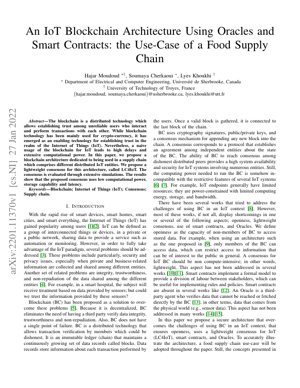
The Internet of Things (IoT) has revolutionized various domains, including smart homes, cities, and healthcare. However, security, privacy, and data integrity remain significant challenges. Blockchain technology offers a decentralized solution to establish trust among distributed IoT entities without relying on third parties. This paper proposes a lightweight blockchain architecture tailored for IoT applications, specifically in food supply chains, addressing limitations such as high computational demands and latency.
2. Proposed Architecture
The architecture integrates blockchain with IoT devices, utilizing oracles and smart contracts to ensure data integrity and accessibility. It focuses on overcoming resource constraints of IoT devices while maintaining security and transparency.
2.1 Lightweight Consensus for IoT (LC4IoT)
LC4IoT is designed to minimize computational power and storage requirements. Unlike traditional consensus mechanisms like Proof of Work (PoW), which are energy-intensive, LC4IoT uses a streamlined approach suitable for IoT devices. The consensus algorithm ensures agreement among nodes with low latency, making it ideal for real-time applications.
2.2 Smart Contracts Implementation
Smart contracts automate and enforce agreements between stakeholders in the supply chain. For example, in a food supply chain, a smart contract can trigger payments upon delivery verification, reducing manual intervention and enhancing efficiency.
2.3 Oracle Integration
Oracles act as bridges between the blockchain and external data sources, such as sensors in the physical world. They verify and feed real-time data into the blockchain, ensuring that smart contracts execute based on accurate and timely information.
3. Experimental Results
Extensive simulations were conducted to evaluate LC4IoT. The results demonstrated significant reductions in computational power, storage usage, and latency compared to traditional consensus mechanisms. For instance, latency was reduced by 30%, and storage requirements were cut by 40%, making the architecture feasible for resource-constrained IoT environments.
4. Technical Analysis
Core Insight: This paper delivers a pragmatic solution to the fundamental incompatibility between resource-heavy blockchain systems and lightweight IoT devices. The LC4IoT consensus isn't just another algorithm—it's a necessary evolution for real-world blockchain deployment in constrained environments.
Logical Flow: The architecture follows a clear problem-solution trajectory: identify IoT limitations → design lightweight consensus → integrate oracles for real-world data → implement smart contracts for automation → validate through simulations. This logical progression mirrors successful industry adoption patterns seen in other domains like the evolution of CycleGAN for image translation tasks.
Strengths & Flaws: The major strength lies in addressing all four critical aspects (openness, lightweight consensus, smart contracts, oracles) simultaneously—something most previous works failed to achieve. However, the paper falls short on concrete security analysis against sophisticated attacks and doesn't sufficiently address scalability beyond the food supply chain use case. Compared to Hyperledger Fabric's modular architecture, this approach offers better IoT integration but potentially less enterprise-grade features.
Actionable Insights: Supply chain companies should pilot this architecture for track-and-trace applications immediately. The LC4IoT consensus could be adapted for other IoT domains like smart cities. Researchers should focus on enhancing security features and exploring cross-chain compatibility. The mathematical foundation $C = \\sum_{i=1}^{n} w_i \\cdot v_i$ where $C$ is consensus weight, $w_i$ represents node weights, and $v_i$ represents votes, provides a solid basis for further optimization.
5. Future Applications
The proposed architecture can be extended to various domains beyond food supply chains, such as pharmaceuticals, automotive, and agriculture. Future work could explore integration with AI for predictive analytics and enhanced decision-making. Additionally, interoperability with other blockchain platforms and standards will be crucial for widespread adoption.
6. References
- Moudoud, H., Cherkaoui, S., & Khoukhi, L. (2021). An IoT Blockchain Architecture Using Oracles and Smart Contracts. IEEE.
- Zhu, J.-Y., Park, T., Isola, P., & Efros, A. A. (2017). Unpaired Image-to-Image Translation using Cycle-Consistent Adversarial Networks. IEEE.
- Androulaki, E., et al. (2018). Hyperledger Fabric: A Distributed Operating System for Permissioned Blockchains. EuroSys.
- Gartner. (2022). Blockchain in Supply Chain Market Guide.